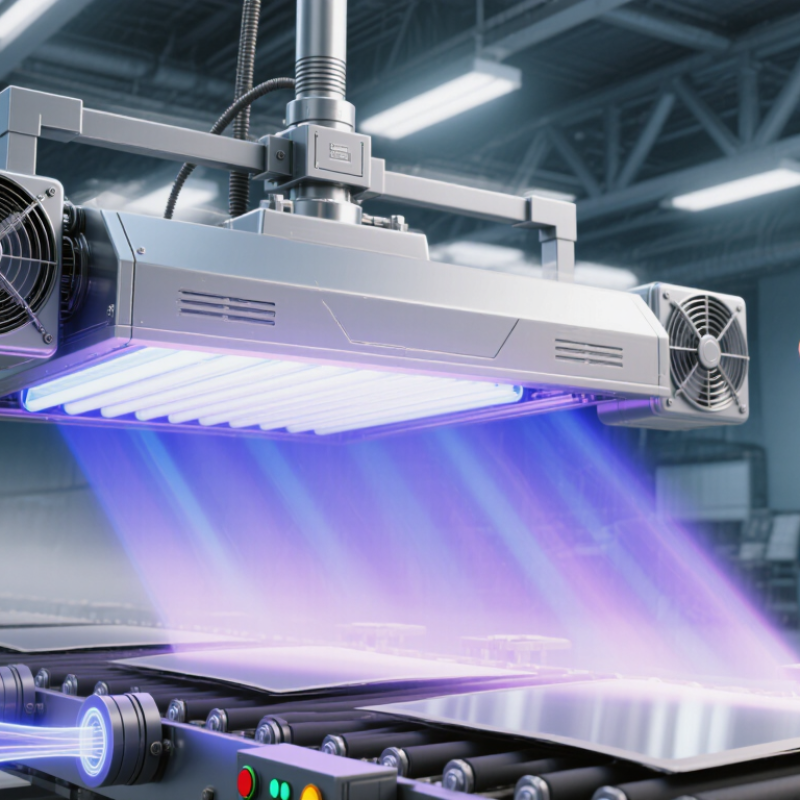
| UV Source | Lamp technology | Mercury vapor lamp: broad UV output
Metal-halide lamp: stronger long-wave UV output
UV LED module: narrow-band output with low heat transfer | General UV curing, coatings, inks, adhesives, electronics assembly, and laboratory exposure systems. | Select a mercury or metal-halide lamp when broad-spectrum energy is required. Select UV LED when the formulation is designed for a specific wavelength and instant on/off operation is important. |
| Wavelength | Peak wavelength | UVA: 315–400 nm
UVB: 280–315 nm
UVC: 100–280 nm
Common UV LED peaks: 365, 385, 395, and 405 nm | UVA is common for curing and inspection; UVB is used in selected photochemical and testing processes; UVC is used for disinfection and surface treatment. | Match the lamp spectrum to the photoinitiator or process chemistry. A lamp with higher wattage is not useful if its wavelength does not overlap the material’s absorption range. |
| Optical Output | UV irradiance at the work surface | Approximately 0.5–20 W/cm² for many air-cooled curing systems; lower or higher values are possible depending on lamp type, optics, and working distance. | Low-intensity inspection and coating exposure through to high-speed adhesive, ink, and resin curing. | Use measured irradiance at the actual work distance rather than electrical input power alone. Confirm whether the specification is peak irradiance or average irradiance. |
| Optical Output | Dose or energy density | Common process values range from approximately 100 mJ/cm² to several J/cm², depending on chemistry and line speed. | UV adhesives, protective coatings, printed inks, conformal coatings, and composite material processing. | Calculate dose using irradiance × exposure time. If the conveyor speed changes, verify that the delivered dose still meets the material supplier’s curing requirement. |
| Electrical System | Electrical input power | Approximately 200 W–6 kW for many air-cooled systems. Compact units may use less, while industrial units may use multiple lamps. | Bench-top curing, small-format printing, laboratory equipment, production lines, and wide-area exposure. | Size the power supply, circuit protection, connectors, and cooling system for the maximum rated input, not the average operating load. |
| Coverage | Effective curing width or spot size | Approximately 10–300 mm for common air-cooled lamp heads; larger widths may require multiple lamps or an optical assembly. | Point curing, narrow bead curing, component assembly, sheet coating, label printing, and web-processing equipment. | Choose a lamp head that covers the complete target area with sufficient irradiance uniformity. Avoid relying on the nominal lamp length alone. |
| Working Distance | Distance from lamp window to substrate | Commonly 5–100 mm, depending on reflector design, optics, safety shielding, and required irradiance. | Close-range spot curing, automated dispensing systems, conveyor curing, and enclosed processing chambers. | Confirm irradiance at the planned distance. UV intensity generally decreases as distance increases, and the actual relationship depends on the reflector and optical design. |
| Cooling | Air-cooling method | Natural convection for low-power units; forced-air cooling with fans or blowers for medium- and high-power systems. | Applications where a water-cooling loop is undesirable or where installation space and maintenance must remain simple. | Check required airflow, inlet air temperature, filter access, fan noise, and exhaust direction. Do not block ventilation openings during installation. |
| Operating Environment | Ambient temperature and humidity | Many systems are designed for approximately 10–40 °C ambient operation and non-condensing humidity; exact limits vary by construction. | Factory floors, laboratories, packaging equipment, and enclosed automation cells. | Select a model rated for the real environment. High ambient temperature, dust, solvents, and restricted airflow can reduce lamp output and service life. |
| Service Life | Useful output life | Mercury and metal-halide lamps commonly provide about 1,000–3,000 operating hours before output declines significantly. UV LED systems commonly provide approximately 10,000–30,000 hours depending on thermal management and output criteria. | Both intermittent and continuous production environments where maintenance intervals affect operating cost. | Compare life based on maintained UV output, not only the time until electrical failure. Include lamp replacement, calibration, downtime, and disposal costs. |
| Process Control | Power adjustment and monitoring | Fixed output, stepped power control, analog control, digital control, timer control, and integrated UV monitoring. | Repeatable industrial curing, automated lines, laboratory development, and processes requiring traceability. | Prefer closed-loop UV monitoring when consistent dose is critical. A lamp-hour counter alone does not measure actual UV output at the work surface. |
| Response Time | Start-up and restart behavior | UV LED systems generally provide near-instant start/stop. Arc lamps may require warm-up and, depending on the lamp and ballast, a cooling period before restart. | High-cycle automation, intermittent curing, continuous production, and energy-sensitive equipment. | Choose LED for frequent cycling and precise exposure timing. For arc lamps, confirm warm-up, restart, and standby requirements with the equipment supplier. |
| Uniformity | Irradiance uniformity across the target area | Typical systems may specify approximately ±10% to ±20% across the effective curing zone; the actual value depends on optics and measurement conditions. | Wide-area coating, printed electronics, display components, optical bonding, and applications sensitive to under-cured regions. | Request a mapped irradiance profile at the actual working distance. A high peak value cannot compensate for uneven coverage or low-energy areas. |
| Safety | UV shielding and interlocks | Enclosed housing, UV-blocking viewing windows, door interlocks, emergency stop integration, warning labels, and exhaust provisions where required. | Production lines, laboratory equipment, maintenance areas, and any installation accessible to operators. | Choose a system that prevents direct and reflected UV exposure. Follow applicable workplace safety rules and use UV-rated personal protective equipment during service. |
| Maintenance | Cleaning and replacement requirements | Periodic cleaning of lamp windows, reflectors, air filters, and cooling paths; lamp replacement or LED module servicing according to output measurements. | Dusty production areas, ink and adhesive processing, and equipment operating for extended shifts. | Select tool-free or front-access maintenance where possible. Confirm replacement part availability, cleaning procedures, calibration requirements, and service access before purchase. |
| Total Cost | Lifecycle operating cost | Includes purchase price, electricity, cooling, consumables, replacement lamps or modules, calibration, labor, downtime, and disposal. | Any application where production uptime and long-term operating cost are more important than initial purchase price. | Compare cost per cured part, cost per operating hour, and delivered UV dose. A lower initial price may result in higher costs if maintenance and replacement intervals are shorter. |