
Choosing the right Pallet Conveyor can shape an entire material-handling system. It affects throughput, labor use, product protection, and long-term maintenance costs. A reliable decision starts with the pallet, not the conveyor catalog. Measure pallet length, width, weight, underside structure, and surface condition. A damaged wooden pallet may behave differently from a rigid plastic one.
Small details matter.
The operating environment also deserves close attention. Cold rooms, dusty floors, washdown areas, and high-temperature zones require different conveyor materials and protection levels. Consider the required speed, accumulation method, transfer points, and available floor space. A roller conveyor may suit stable loads, while a chain conveyor can handle pallets with unusual bottom supports. Gravity sections may reduce energy use, but they need careful slope control.
Do not overlook controls and maintenance access. Sensors should detect gaps consistently, and emergency stops must remain easy to reach. Ask how technicians will replace rollers, inspect bearings, and clear a jam. These questions often reveal weaknesses before installation.
A practical evaluation should compare capacity, safety features, noise, energy consumption, integration needs, and total ownership cost. Supplier drawings, load tests, and reference projects can support a more dependable choice. Still, no selection is perfect. Forecasts change, and real pallets are rarely identical. A flexible layout may be worth more than a slightly cheaper machine.
Before approving the design, test representative pallets under realistic conditions. Watch the transfers. Listen for vibration. Record where delays appear. That evidence can turn a promising concept into a dependable Pallet Conveyor system.
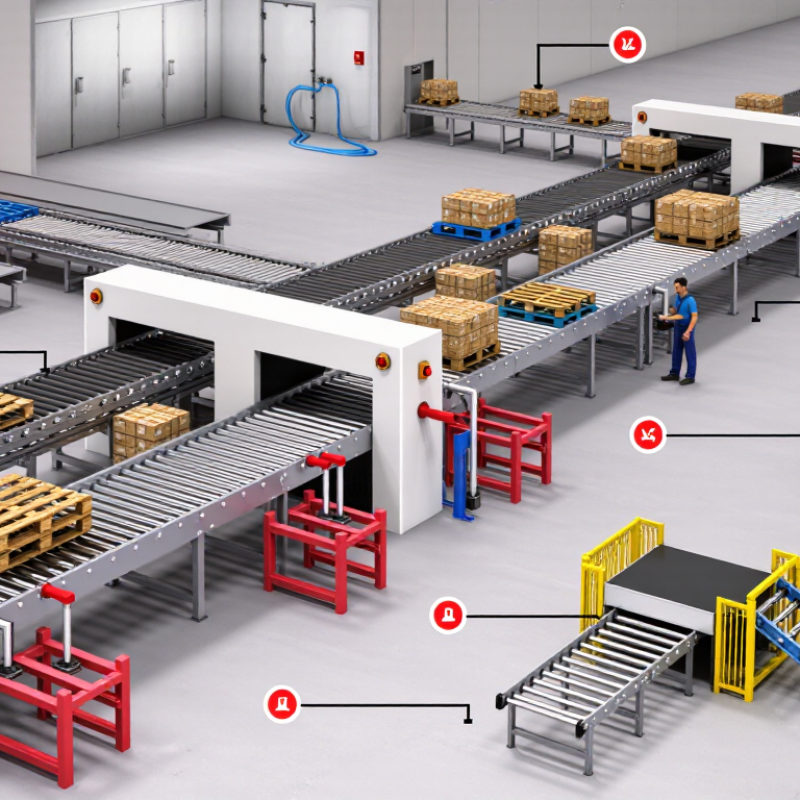
How to Choose the Right Pallet Conveyor?
Define the Load, Pallet, and Material-Handling Requirements
Start with the load, not the conveyor frame. Record the minimum, average, and maximum pallet weight, including unstable cartons or liquid containers. Measure pallet length, width, height, and underside openings. ISO 6780 identifies several internationally used pallet dimensions, but actual operations often include mixed sizes. That variation can cause unexpected transfers and jams.
A pallet weighing 800 kilograms needs different rollers than a 300-kilogram unit. Check the load’s center of gravity, bottom-board condition, and surface friction. A damaged board may pass inspection but fail during accumulation. It happens. Define the required speed, spacing, accumulation pressure, and hourly throughput using measured production data. MHI’s 2024 Annual Industry Report found that 55% of supply-chain professionals planned to increase automation investment, making accurate requirements more important before purchasing equipment.
Review the handling environment carefully. Dust, moisture, temperature, washdown routines, and available floor space can change component selection. Ask whether operators will load pallets manually or with powered equipment. Confirm aisle width and maintenance access. A short conveyor may look efficient, yet poor access can create longer downtime. I have seen specifications focus heavily on speed while ignoring pallet quality. That mistake deserves a second review. Build the design around real pallets, real loads, and the least stable operating condition.
Choosing a pallet conveyor starts with the facility, not the equipment catalog. Map receiving, storage, picking, staging, and shipping areas first. Then measure pallet dimensions, load weights, daily volume, peak-hour flow, and available clearance. A roller conveyor suits stable pallets and controlled accumulation. A chain conveyor handles heavier or uneven loads. Belt systems can provide smoother movement, but they may require more cleaning and maintenance access.
Layout decisions should reflect real travel patterns. Keep inbound and outbound routes separate where possible. Reduce crossings near forklift aisles and emergency access points.
The 2024 MHI Annual Industry Report states that 55% of supply chain leaders planned to increase technology investment within two years. That investment should improve flow, not simply add automation.
A short conveyor can outperform a longer system when it removes repeated handling. I have seen projects fail because designers used average volume instead of peak demand. It looked efficient on paper.
Tips: Leave service space beside drives, sensors, and transfer points. Test the layout with empty and fully loaded pallets. Check future SKU and volume changes. Allow manual bypass points for maintenance and unusual loads. ASCM planning guidance emphasizes aligning capacity with demand variability, yet many layouts still use one fixed rate. That assumption deserves review. Mark noise zones, pedestrian crossings, and operator sightlines before final approval. Small details matter.
Choosing the right pallet conveyor starts with understanding your daily capacity, not the available floor space. Count average pallets per hour, peak surges, pallet weights, and the busiest shift. A conveyor rated for normal demand may fail during seasonal spikes. Leave practical reserve capacity, usually 15 to 25 percent, for unexpected volume.
Speed must match the complete workflow. A fast conveyor cannot improve a slow loading station. Measure travel distance, pallet spacing, picking time, and transfer points. Heavy or unstable pallets may need slower movement and controlled acceleration. Test different speeds with real pallets. Small variations can reveal noise, shifting loads, or unsafe stops. We sometimes overestimate speed and underestimate accumulation space.
Tips: Map the pallet flow before selecting equipment. Mark loading, inspection, storage, and dispatch zones. Check whether pallets move continuously, queue temporarily, or change direction. Choose roller spacing and conveyor width according to pallet dimensions and bottom-board condition. Include sensors, emergency stops, and access points for maintenance. Ask operators where jams usually occur; their experience often exposes problems that drawings miss. A perfect calculation is rare. Recheck your assumptions after a trial run.
How to Choose the Right Pallet Conveyor?
Choosing a pallet conveyor starts with load facts, not catalog dimensions. Record pallet weight, width, underside condition, and required speed. Roller drives suit many loads, while chain-driven sections handle rough pallets more confidently. Belt systems can reduce noise, but heat, dust, and friction need checking. A variable-speed motor may improve flow, yet excessive adjustment can confuse operators. Controls should show jams clearly and allow safe local isolation. Use sensors at transfers, accumulation zones, and entry points.
Safety design should be observed on the floor, not only in drawings. Guard nip points, provide emergency stops, and make restart logic deliberate. Verify guarding and control circuits against applicable machinery safety requirements. Clear access around motors helps technicians inspect chains, bearings, and sensors. Choose components with accessible lubrication points and documented replacement intervals. In my experience, maintenance plans fail when cleaning time is ignored. Dust may seem minor, then become the main fault source. A conveyor can look efficient on paper and still frustrate a shift team.
Tips: Run a loaded trial before approval. Measure stopping distance at normal speed. Listen for uneven roller noise. Test recovery after a power interruption. Ask maintenance staff to challenge the layout. Their criticism may reveal a cheaper repair today, or an expensive redesign later.
Comparison of drive systems, controls, safety, and maintenance using a 1–5 engineering suitability score
Motor-driven roller conveyors provide balanced performance for general pallet handling. Chain-driven systems are typically better for heavy loads and harsh environments, while belt conveyors offer smooth product movement but may require more cleaning and belt maintenance. Zero-pressure accumulation systems provide the strongest control and safety performance when pallet spacing, sensors, and zone logic are critical. Final selection should consider pallet weight, throughput, environment, guarding, emergency stops, and required maintenance access.
How to Choose the Right Pallet Conveyor?
Assess Installation Costs, Scalability, and Long-Term Value
Choosing a pallet conveyor starts with the building, not the catalog. Measure clear heights, floor slopes, loading zones, and pedestrian routes. A site survey should record pallet dimensions, weights, throughput, and shift patterns. Field experience shows that misplaced columns often cause costly redesigns. They are expensive surprises. Ask installers to separate equipment, controls, freight, electrical work, floor preparation, and commissioning costs. A low quote may exclude guarding or weekend installation. Request a written scope with clear assumptions.
Scalability requires a physical plan. Leave service access beside drives and room for future conveyor sections. Specify accumulation capacity, speed ranges, transfer points, and control-system interfaces before construction. For example, a line handling 40 pallets per hour may need space for 60 pallets during peak periods. That buffer protects production, but it also consumes floor space. Check whether the frame, motor capacity, and controls can support expansion. Not every modular design expands cheaply.
Long-term value depends on more than purchase price. Compare energy use, lubrication needs, spare-parts availability, training, inspection time, and expected downtime. Ask for maintenance intervals and realistic response times, not vague service promises. A five-year cost model can include labor, replacement rollers, electricity, and lost production. Use measured site data where possible. I would also test a loaded pallet during acceptance, because an empty conveyor can hide vibration and stopping problems. Forecasts are rarely perfect. Build adjustable controls and review performance after the first operating quarter.
| Conveyor Type | Best-Fit Application | Typical Load Range | Typical Installed Cost* | Installation Complexity | Scalability | Typical Speed | Maintenance Demand | Long-Term Value |
|---|---|---|---|---|---|---|---|---|
| Gravity Roller Conveyor | Low-volume pallet movement, staging lanes, loading and unloading areas, and short straight transfers. | 500–3,000 lb per pallet | $100–$250 per linear foot | Low; usually requires limited electrical work and simple floor preparation. | Moderate; additional straight sections are easy to add, but routing and accumulation options are limited. | Up to approximately 60 ft/min, depending on slope and load. | Low; inspect rollers, bearings, frame alignment, and accumulated debris. | High for simple, low-throughput layouts |
| Powered Roller Conveyor | General warehouse conveying, controlled pallet transport, accumulation, and moderate-throughput production lines. | 500–4,000 lb per pallet | $250–$600 per linear foot | Moderate; requires motors, controls, guarding, and electrical installation. | High; zones, transfers, sensors, and additional conveyor sections can be integrated. | Up to approximately 150 ft/min, depending on design and load. | Moderate; inspect drive components, chains or belts, sensors, and control panels. | High for flexible warehouse and distribution use |
| Chain-Driven Roller Conveyor | Heavy-duty pallet handling, manufacturing plants, and applications requiring positive pallet control. | 1,000–6,000 lb per pallet | $350–$800 per linear foot | Moderate to high; requires structural support, drive alignment, guarding, and electrical connections. | High; suitable for long lines, transfers, stops, and automated routing. | Up to approximately 100 ft/min, depending on load and layout. | Moderate; chain tension, lubrication, sprockets, bearings, and drive units need scheduled inspection. | Very high for heavy loads and frequent cycling |
| Belt Conveyor | Applications requiring stable movement, smooth transfers, incline or decline conveying, and mixed pallet surfaces. | 500–3,000 lb per pallet | $300–$750 per linear foot | Moderate; belt tracking, take-up space, guarding, and electrical work must be planned. | Moderate to high; routing is adaptable, but belt width and incline limits may affect expansion. | Up to approximately 200 ft/min, depending on belt type and load. | Moderate; inspect belt tension, tracking, splice condition, pulleys, and motor components. | High where controlled and continuous transport is required |
| Pallet Shuttle Conveyor | High-throughput distribution centers, automated storage systems, and layouts requiring accumulation without constant line pressure. | 1,000–4,000 lb per pallet | $500–$1,200 per linear foot | High; requires controls integration, sensors, safety systems, and accurate commissioning. | Very high; modular zones and automated accumulation can support future throughput increases. | Typically 100–300 ft/min, depending on configuration and control strategy. | Moderate to high; service includes sensors, drive modules, controls, and shuttle components. | Very high for high-volume automated operations |
| Pallet Transfer Car | Cross-aisle movement, multi-line production systems, and facilities where pallets must be routed between parallel conveyor lanes. | 1,000–6,000 lb per pallet | $100,000–$300,000 per system | High; requires rail or track installation, structural coordination, controls, and safety interlocks. | High; can serve multiple conveyor lanes, although floor space and track geometry limit changes. | Approximately 100–300 ft/min travel speed | Moderate to high; inspect wheels, rails, drive components, sensors, and safety devices. | High for multi-lane routing and space-efficient layouts |
| Vertical Reciprocating Conveyor | Multi-level warehouses, mezzanines, production floors, and facilities with limited horizontal space. | 1,000–6,000 lb per pallet | $75,000–$250,000 per unit | High; requires structural openings, guarding, multiple safety devices, and building-code review. | Moderate; additional levels may require new equipment or structural changes. | Approximately 20–60 ft/min vertical travel | Moderate; inspect lifting mechanisms, chains or belts, door interlocks, sensors, and brakes. | High where vertical space reduces building expansion costs |
Northeast Battery, a Stored Energy Holdings, Inc. Company